


Best Web Design Courses in 2026: 10 Picks Compared

Eneba Hub contains affiliate links, which means we may earn a small commission if you make a purchase through them—at no extra cost to you. Learn more


FIND YOUR STARTING POINT
Start with HTML, CSS, and Javascript for Web Developers on Coursera for coding fundamentals. Choose a beginner specialization, a free visual-builder course, or live certificate study to match your goal.
The best web design courses include HTML, CSS, and Javascript for Web Developers for coding fundamentals, The Art of Doing for beginners, and Web Design for Beginners: Using WYSIWYG Web Builder as the free pick. For live certificate study, American Graphics Institute lists $3,995 tuition and 96 hours of instruction. Start with a web design course format that helps you finish a useful website.
These web design courses suit first-time learners, career-changers, and people adding website skills to an existing role. Web design education covers different goals: arranging a page, writing its code, or earning an academic credential. Training for web designers should match that goal before it matches a familiar provider name.
The list of web design courses spans free lessons, focused coding courses, specializations, a course bundle, and certificate programs. Prices use their stated billing basis, so a subscription, a course purchase, and a per-credit tuition rate remain separate. Completion time also depends on the practice and revision you add to the lessons.
Jump to:
Best Web Design Courses at a Glance
The best web design courses here serve different goals, so compare the intended outcome first. This table keeps visual design, coding, and academic study distinct. An online course on website design can introduce a tool, guide a complete build, or form part of a longer credential. Prices and study commitments appear in each course’s facts card.
|
Course |
Provider |
Best for |
Main Focus |
|---|---|---|---|
|
HTML, CSS, and Javascript for Web Developers |
 |
Best Overall |
Website coding fundamentals |
|
The Art of Doing – Web Development for Beginners Specialization |
|
Best for Beginners |
Progressive beginner projects |
|
Web Design for Beginners: Using WYSIWYG Web Builder |
 |
Best Free Option |
Visual portfolio building |
|
The Complete Front-End Web Development Course |
|
Best Budget Pick |
Front-end coding practice |
|
Web Design Certificate |
 |
Best Certificate |
Live design and coding instruction |
|
Responsive Web Design Specialization |
|
Best for Responsive Design |
Layouts across screen sizes |
|
Introduction to UI and UX Design |
 |
Best for UI/UX Basics |
Wireframes and prototypes |
|
Build a Portfolio Website with HTML, CSS, and JavaScript |
|
Best for Quick Projects |
Guided portfolio practice |
|
One Month Web Development Bundle |
 |
Best Course Bundle |
Coding and responsive design |
|
Online Certificate Program in Website Design and Development |
 |
Best College-Credit Program |
Academic design or development study |
The web design courses run from the overall recommendation through beginner, free, budget, certificate, and specialty picks. Their order reflects purpose, not a comparison of ratings across providers.
What Is Web Design?
Web design is the layout, visual style, and usability of a website. It covers how visitors find information, understand a page, and use its controls. Web design education through a web design course should connect those choices to the way a page behaves on different screens.
The web designer vs web developer distinction concerns emphasis: designers shape the interface, while developers write the code behind its appearance and behavior. Web design and development courses often overlap because HTML structure and CSS styling affect both. A useful online course on website design explains that connection through practice.
People pursue web design courses for freelance work, in-house roles, or projects within an existing job. Training for web designers should include readable typography, responsive layout, and clear navigation. Responsive means a layout adapts to the available screen space.
The best web design courses also leave room for visual planning. A wireframe maps page structure, while a prototype models interaction. Use Figma or a similar tool to explore layout decisions before building a page in your web design course.
How These Web Design Courses Were Chosen
These web design courses emphasize clear scope, practical work, and understandable costs. The best web design courses make their intended learner clear. Training for web designers was considered through these criteria:
- Coverage: HTML, CSS, JavaScript, responsive layouts, or interface design.
- Teaching source: The institution, provider, or instructor named on the course page.
- Ratings: Provider-specific scores with their review counts, kept separate across platforms.
- Price: Course purchases, subscription offers, and tuition shown with their billing basis.
- Practice: Portfolio builds, coding exercises, prototypes, or guided projects.
- Credential: The completion certificate or academic award described by the provider.
Good web design education connects the course’s promise to work you can complete. Enrollment totals provide context for comparing web design courses, while the syllabus should decide the purchase.
The 10 Best Web Design Courses, Reviewed
Start with the course that matches your next project. These web design courses move from broad coding foundations to specialized design work and academic study. The web designer vs web developer distinction becomes easier to judge once you compare the work that web design and development courses ask you to produce.
1. Best Overall: HTML, CSS, and Javascript for Web Developers (Coursera)
This is the strongest general starting point for readers who want to understand how a website is built. It brings structure, styling, and interaction into the same web design course, which makes the relationship between those skills easier to follow.
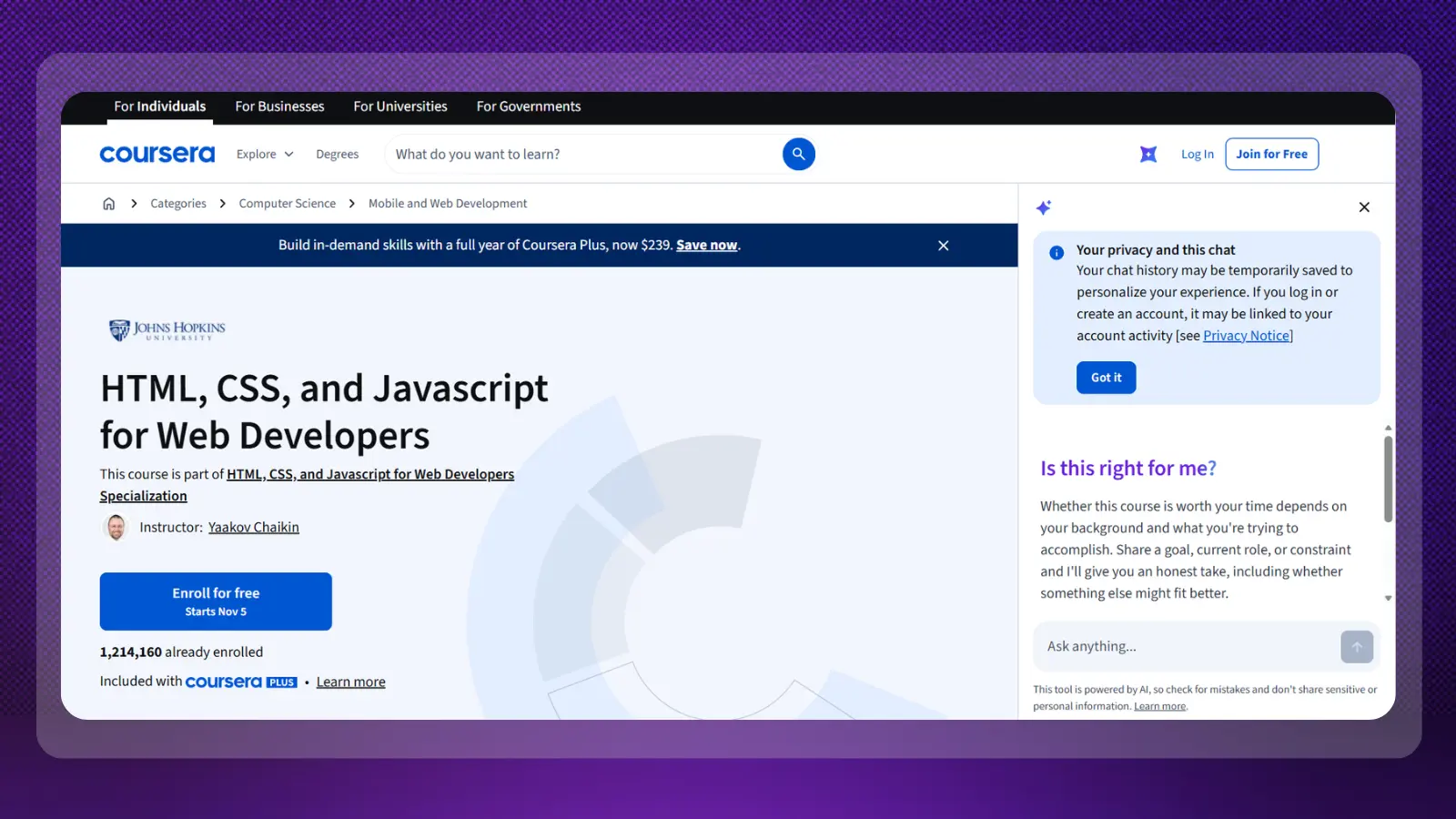
Coursera presents a coding-focused web design course covering HTML, CSS, responsive pages, and introductory JavaScript. Its HTML, CSS, and Javascript for Web Developers page lists 4 hours to complete and a 4.7 rating from 17,177 reviews. Treat the listed duration as a study reference and leave room to rebuild examples on your own.
Among the best web design courses, this pick suits learners who want the code behind a page to make sense. An online course on website design becomes more useful when you change the example content and see what breaks.
Adapt a web design course lesson into a game studio landing page for practice. Web design education should help you explain why a heading, image, or navigation element belongs where you placed it. The web designer vs web developer distinction is useful here: you are exploring visual decisions through implementation.
The provider’s key web design course details are summarized here.
| Provider | Coursera |
| Price | Course page advertises a $239 annual Coursera Plus offer |
| Difficulty | Beginner |
| Time | 4 hours to complete |
| Certificate | Shareable course completion certificate |
| Rating | 4.7 from 17,177 reviews |
The shareable course completion certificate records finished study and is not an exam-based vendor certification. Compare the learning benefits with the scope limits before enrolling.
| Pros | Cons |
|---|---|
| ✅ Connected skills – HTML, CSS, and JavaScript together ✅ Responsive focus – links styling to screen size ✅ Compact format – a focused coding introduction ✅ Review context – a published score and review count | ❌ Coding emphasis – visual design needs separate practice ❌ Subscription offer – annual access differs from a course purchase |
Training for web designers should result in choices you can explain. This course is a practical foundation for further web design and development courses, particularly when you build a second version without copying the lesson.
2. Best for Beginners: The Art of Doing – Web Development for Beginners Specialization (Coursera)
This beginner specialization offers a clearer progression for someone who wants a continuing learning path. Choose it over a short web design course when you want HTML, CSS, and JavaScript introduced as connected stages.
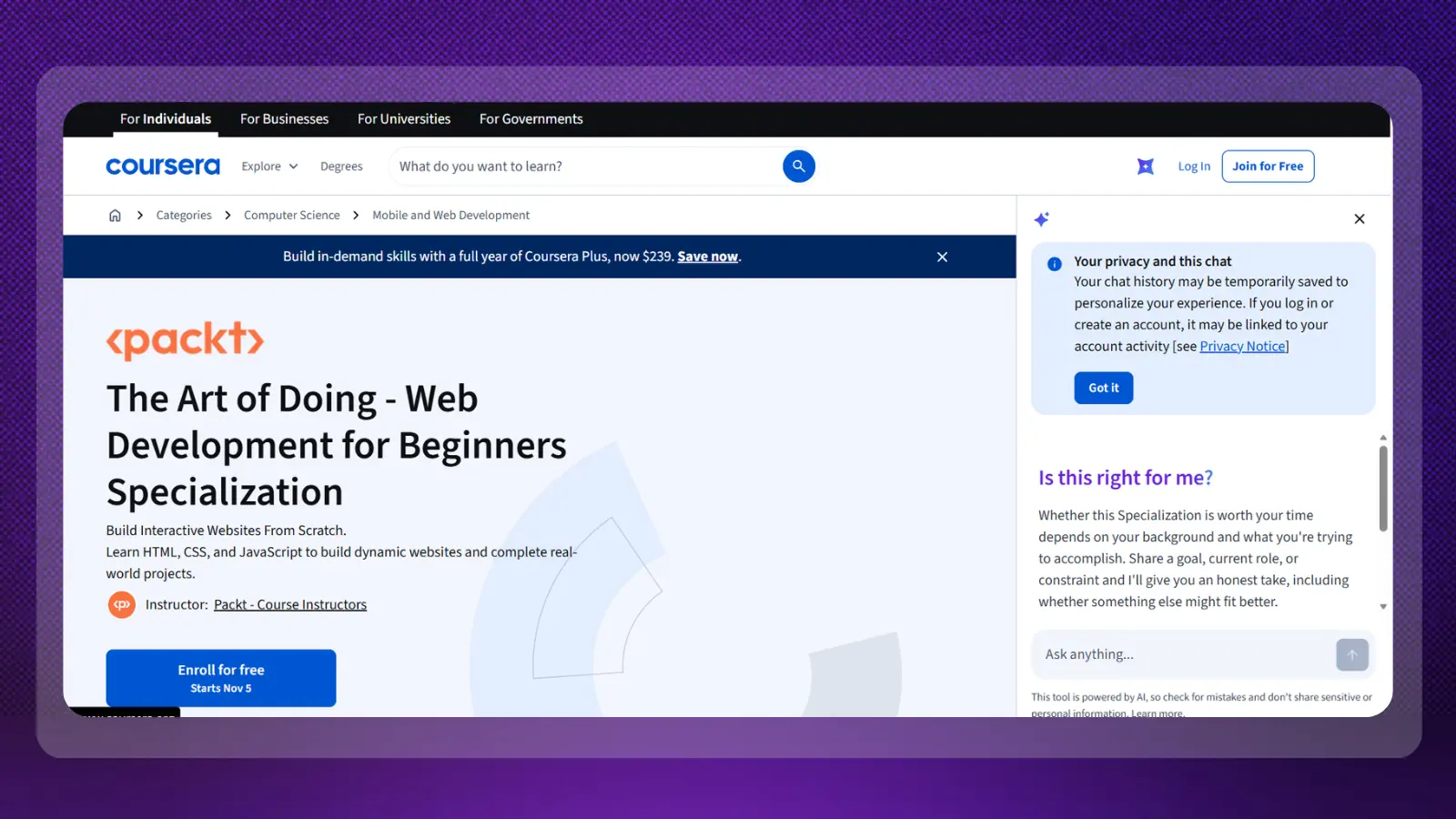
Available through Coursera, this web design course series moves from HTML structure to CSS layouts and JavaScript interaction. The projects include portfolio and storefront work. This makes it relevant to readers comparing web design and development courses for a first complete website.
The Coursera page lists 4 weeks at 10 hours a week, beginner difficulty, and a 5.0 rating from 8 reviews. A beginner web design course syllabus deserves more weight than that small review base. Training for web designers should offer manageable progression before it offers an impressive score.
An online course on website design also needs room for repetition. Rebuild a web design course portfolio section with different content before moving to the next topic. That habit turns web design education into a skill you can reuse.
These are the specialization’s listed details.
| Provider | Coursera |
| Price | Course page advertises a $239 annual Coursera Plus offer |
| Difficulty | Beginner |
| Time | 4 weeks at 10 hours a week |
| Certificate | Shareable certificate |
| Rating | 5.0 from 8 reviews |
The structured path is its main advantage. These trade-offs help distinguish it from shorter web design courses.
| Pros | Cons |
|---|---|
| ✅ Beginner level – a clearly stated starting audience ✅ Progressive topics – structure, layout, and interaction ✅ Project variety – portfolio and storefront examples ✅ Completion credential – a shareable certificate | ❌ Small review base – limited learner feedback ❌ Sustained commitment – a broader path than a short introduction |
The web designer vs web developer choice can remain open while you learn these foundations. Pay attention to the work you enjoy: arranging content, styling components, or programming behavior. A beginner web design course is a useful place to discover that preference.
3. Best Free Option: Web Design for Beginners: Using WYSIWYG Web Builder (Udemy)
This is the free pick for readers who want to build visually. It is among the best web design courses for exploring page composition through a visual website builder.
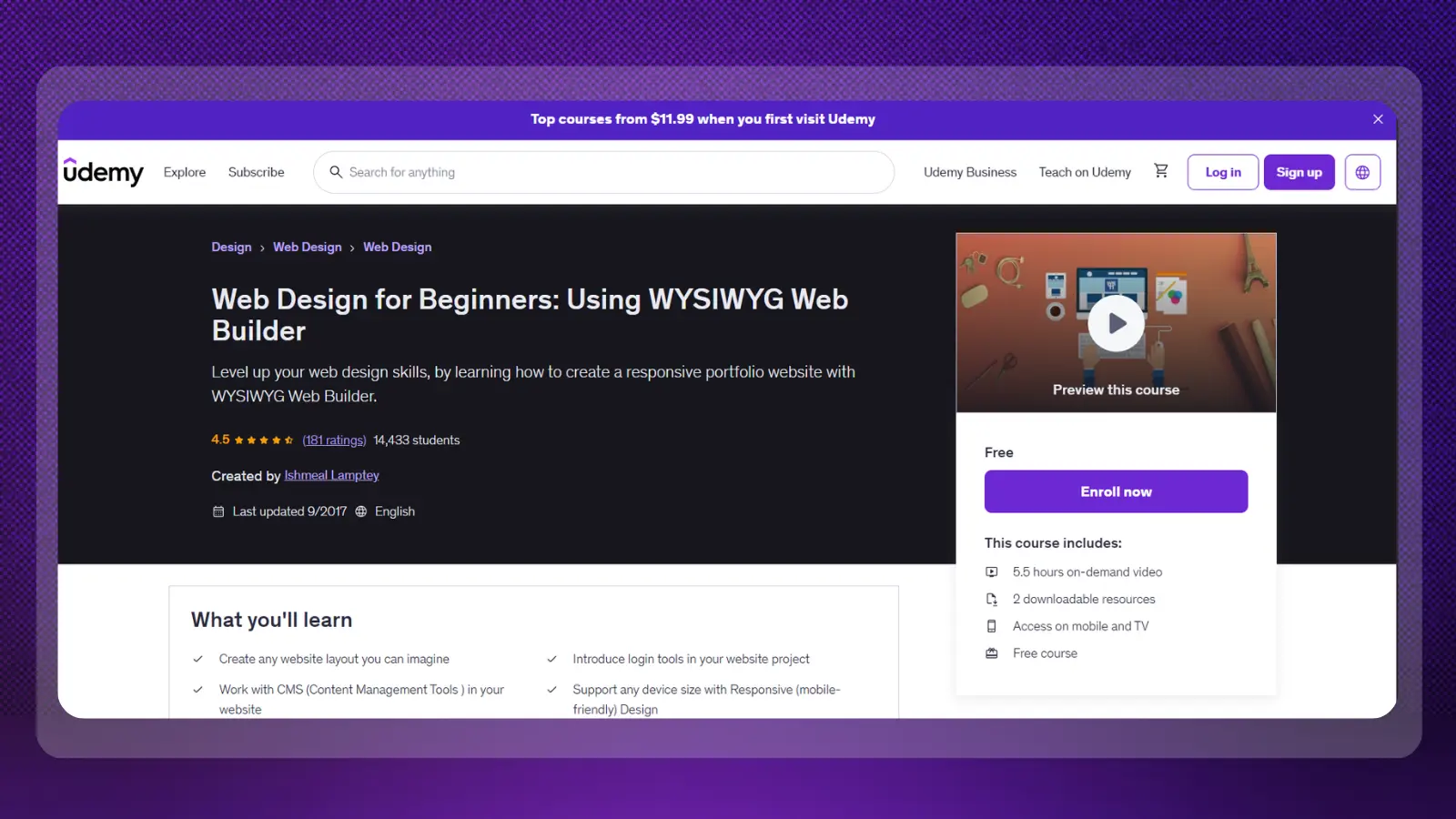
The Udemy web design course uses WYSIWYG Web Builder to create a responsive portfolio. WYSIWYG means “what you see is what you get”: the editing interface presents the page visually. The course covers portfolio sections, content management, login-related pages, and search-engine basics.
Udemy lists the course as free, with 5.5 hours of on-demand video and a 4.5 rating from 181 reviews. Free web design course access describes the lessons. Treat software access as a separate budget decision.
This online course on website design is useful if arranging a page interests you more than writing code immediately. The web designer vs web developer distinction is particularly relevant: a visual build develops layout familiarity, while code-focused web design and development courses address implementation more directly.
Here is the course’s published information.
| Provider | Udemy |
| Price | Free |
| Difficulty | Beginner |
| Time | 5.5 hours on-demand video |
| Certificate | Not included |
| Rating | 4.5 from 181 reviews |
This web design course offers a concrete project, with some limits for learners seeking portable coding skills.
| Pros | Cons |
|---|---|
| ✅ Free lessons – no course purchase required ✅ Portfolio focus – work toward a complete site ✅ Visual workflow – explore layout through a builder ✅ Responsive practice – consider different screen sizes | ❌ Tool-specific workflow – skills center on the named builder ❌ Credential detail – no certificate listed by the provider |
Use this web design course to create a clear portfolio hierarchy: introduction, selected work, and contact information. Training for web designers becomes more transferable when you can explain the layout without referring to a particular tool. Follow with broader web design education if you want to edit the generated code confidently.
4. Best Budget Pick: The Complete Front-End Web Development Course (Udemy)
This web design course is the budget recommendation for readers who want a clearly stated individual purchase price. Its broader coding coverage makes it useful for learners ready to spend more time building.
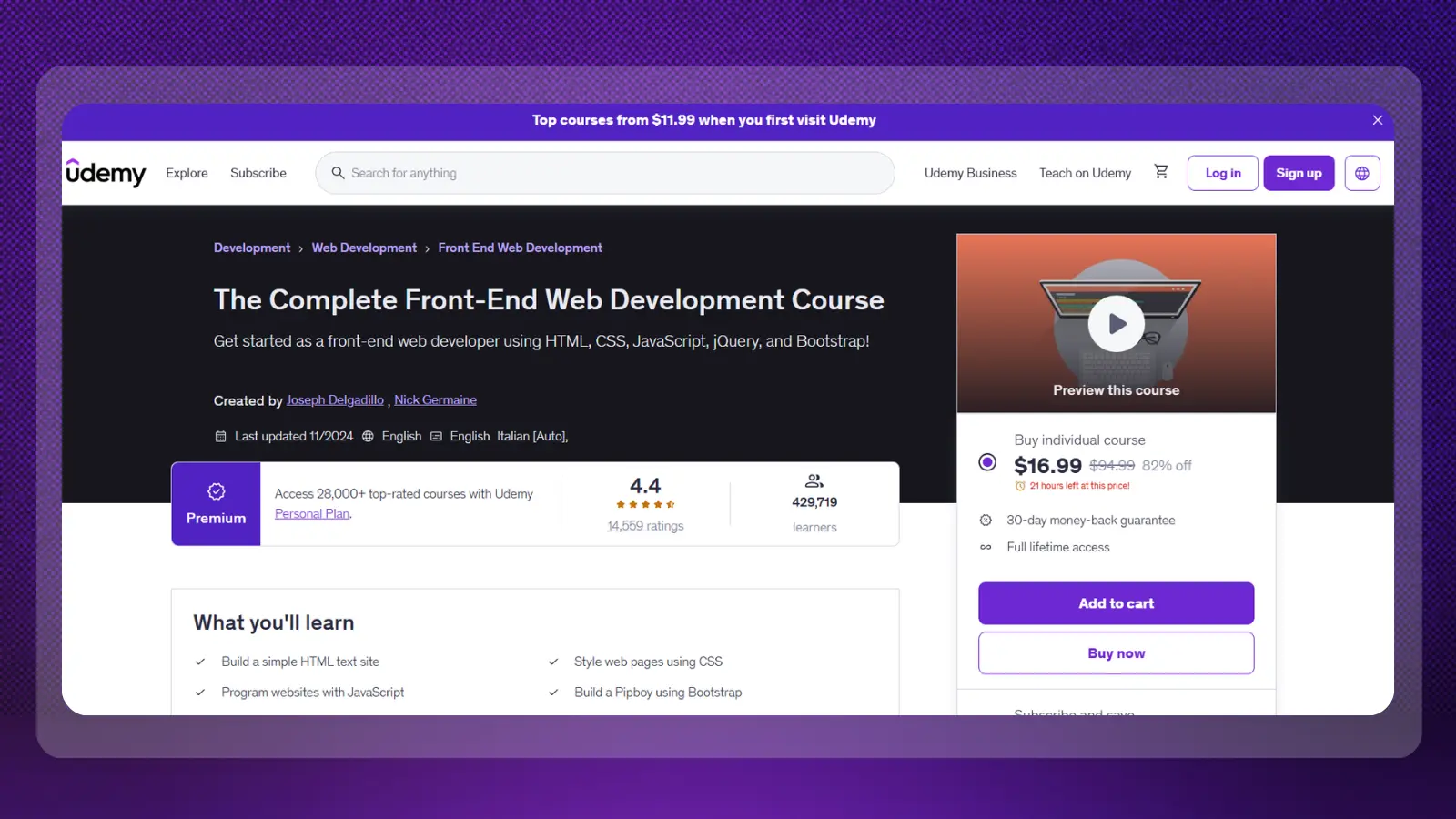
Udemy‘s web design course covers HTML, CSS, JavaScript, and Bootstrap, a framework of reusable interface and layout components. Coding exercises and projects connect the lessons. That scope suits shoppers comparing web design and development courses for practical front-end work.
Udemy lists $94.99 for the course, Personal Plan access starting at $13.00/month, and 17 hours of on-demand video. Its rating is 4.4 from 14,559 ratings. Compare the one-time purchase with the recurring plan according to how you intend to study.
Among the best web design courses, this is a sensible paid step after trying basic coding. An online course on website design should earn its price through exercises you complete, so preview the teaching format before choosing access.
Listed web design course terms appear below.
| Provider | Udemy |
| Price | $94.99 purchase or Personal Plan starting at $13.00/month |
| Difficulty | All levels |
| Time | 17 hours on-demand video |
| Certificate | Certificate of completion |
| Rating | 4.4 from 14,559 ratings |
The purchase option and practical scope are useful, with these trade-offs.
| Pros | Cons |
|---|---|
| ✅ Purchase option – an individual course price ✅ Broad foundations – HTML, CSS, and JavaScript ✅ Framework exposure – includes Bootstrap ✅ Completion certificate – included in the course listing | ❌ Recurring alternative – Personal Plan renews by subscription ❌ Development emphasis – visual design needs more study |
The web designer vs web developer distinction points toward this course’s main strength: implementation. Add typography and usability practice alongside the web design course to round out your web design education. Training for web designers should connect a functioning page with a page that visitors can understand.
5. Best Certificate: Web Design Certificate (American Graphics Institute)
Choose this program of web design courses when live instruction and a defined certificate pathway justify a larger commitment. It belongs among the best web design courses for learners who want scheduled teaching across design and coding topics.
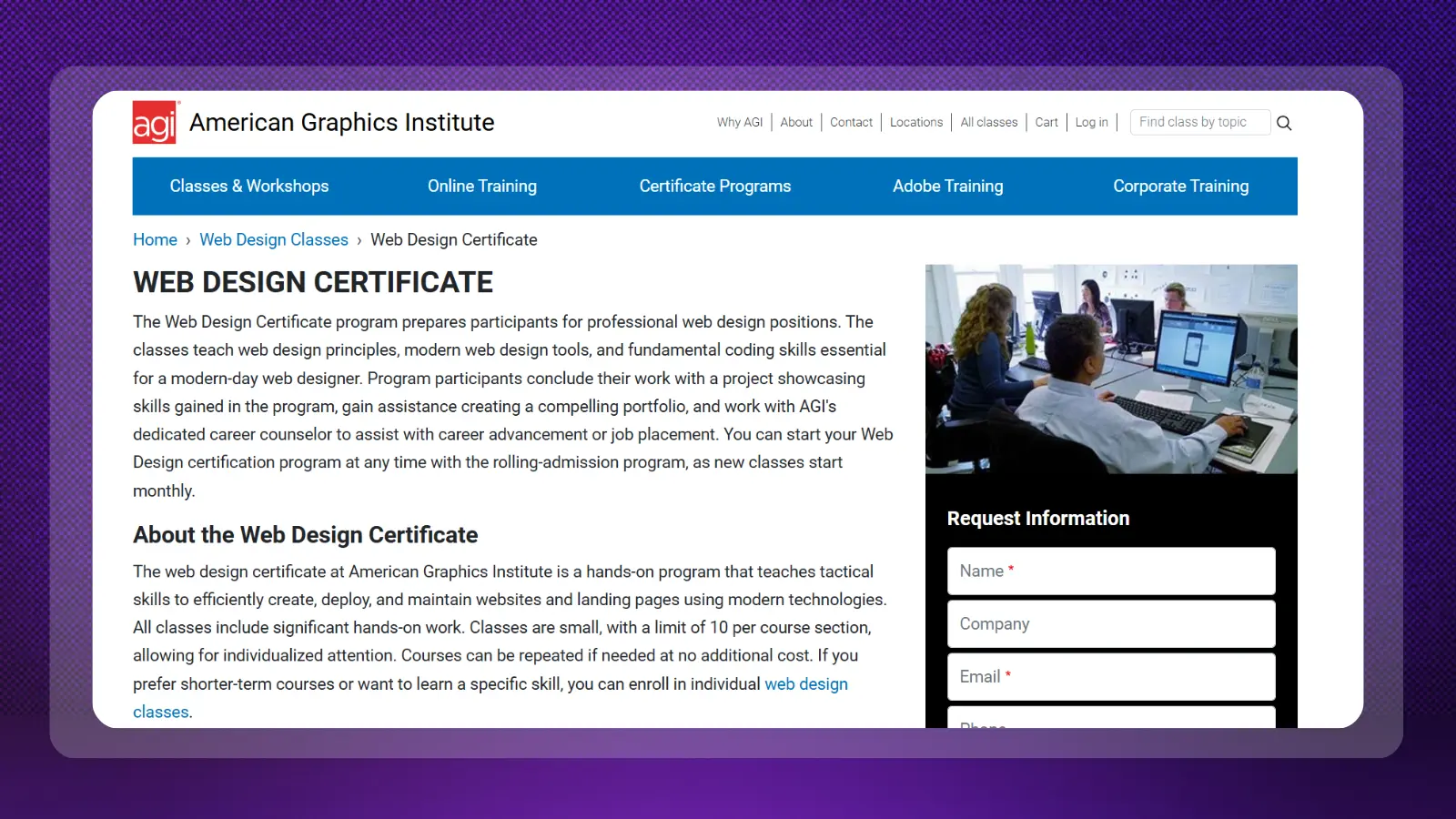
American Graphics Institute combines UX design, introductory and advanced Figma study, and an HTML introduction. That combination provides a design-centered alternative to the coding-heavy web design courses above. The provider format is live and instructor-led.
American Graphics Institute lists $3,995 tuition, 96 hours of live instruction, and a schedule of 6 weeks full-time or up to 52 weeks part-time. These details make the commitment easier to assess than an open-ended online course on website design.
The web designer vs web developer distinction helps explain its appeal: interface planning and visual tools receive explicit attention alongside HTML. Training for web designers who want feedback can benefit from scheduled teaching, provided the class timetable fits their other responsibilities.
Key details for this program of web design courses are below.
| Provider | American Graphics Institute |
| Price | $3,995 tuition |
| Difficulty | Not listed by the provider |
| Time | 96 hours, 6 weeks full-time or up to 52 weeks part-time |
| Certificate | Web Design Certificate |
| Rating | Not listed by the provider |
Compare the teaching format with its financial and scheduling demands.
| Pros | Cons |
|---|---|
| ✅ Live teaching – instructor-led classes ✅ Design coverage – UX and visual planning ✅ Tool progression – introductory and advanced Figma ✅ Schedule choices – full-time or part-time study | ❌ Higher commitment – substantial tuition compared with short courses ❌ Scheduled attendance – less flexible than on-demand lessons |
This route makes sense when your web design education needs an organized program. It is a larger purchase than most web design and development courses here, so connect the curriculum to a specific learning gap. A certificate becomes more useful when accompanied by projects you can discuss confidently.
6. Best for Responsive Design: Responsive Web Design Specialization (Coursera)
This specialization suits learners who already understand the basics and want stronger layout skills. Its intermediate level makes it a follow-on web design course for pages that need to work across screen sizes.
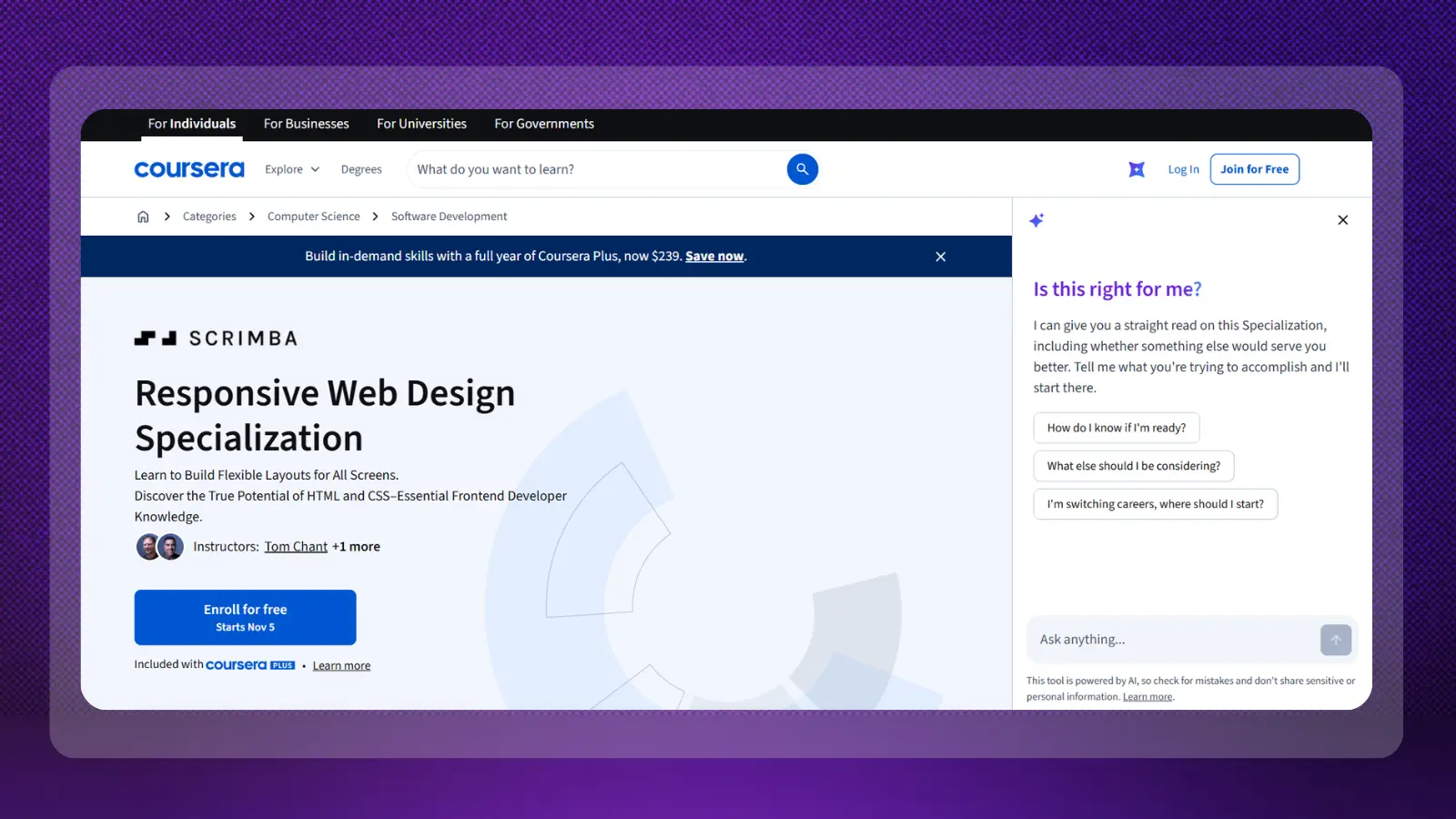
The Coursera specialization covers responsive sites, a product splash page, CSS Grid, and project deployment with Netlify. CSS Grid, part of this web design course, is a layout system for arranging content in rows and columns. These subjects make the course relevant to practical training for web designers.
Coursera lists intermediate difficulty, 4 weeks to complete, and a 4.7 rating from 30 reviews. The web design course description also gives about 20 hours of lessons and advises allowing substantially more time for the coding work.
Among the best web design courses for improving an existing skill, this one has a useful focus. An online course on website design should make you test the awkward cases: long headings, narrow screens, and images with different proportions.
These are the specialization’s listed facts.
| Provider | Coursera |
| Price | Course page advertises a $239 annual Coursera Plus offer |
| Difficulty | Intermediate |
| Time | 4 weeks to complete, with about 20 hours of lessons |
| Certificate | Shareable certificate |
| Rating | 4.7 from 30 reviews |
A specialized web design course is valuable once foundational HTML and CSS feel familiar.
| Pros | Cons |
|---|---|
| ✅ Focused topic – responsive layout throughout ✅ Modern layout practice – includes CSS Grid ✅ Project publishing – deployment with Netlify ✅ Defined level – clearly marked intermediate | ❌ Prerequisite knowledge – a less suitable first coding course ❌ Extra practice time – lesson runtime excludes much of the work |
Responsive layouts require both visual planning and HTML/CSS implementation. If you are comparing web designer vs web developer roles, use this specialization after building a simple page independently.
7. Best for UI/UX Basics: Introduction to UI and UX Design (Codecademy)
This web design course is for readers who want to understand interface planning before committing to a coding path. It broadens the list beyond web design courses centered on HTML and CSS. UI means user interface: the controls and visual elements a person uses. UX means user experience: how effectively that person can complete a task.
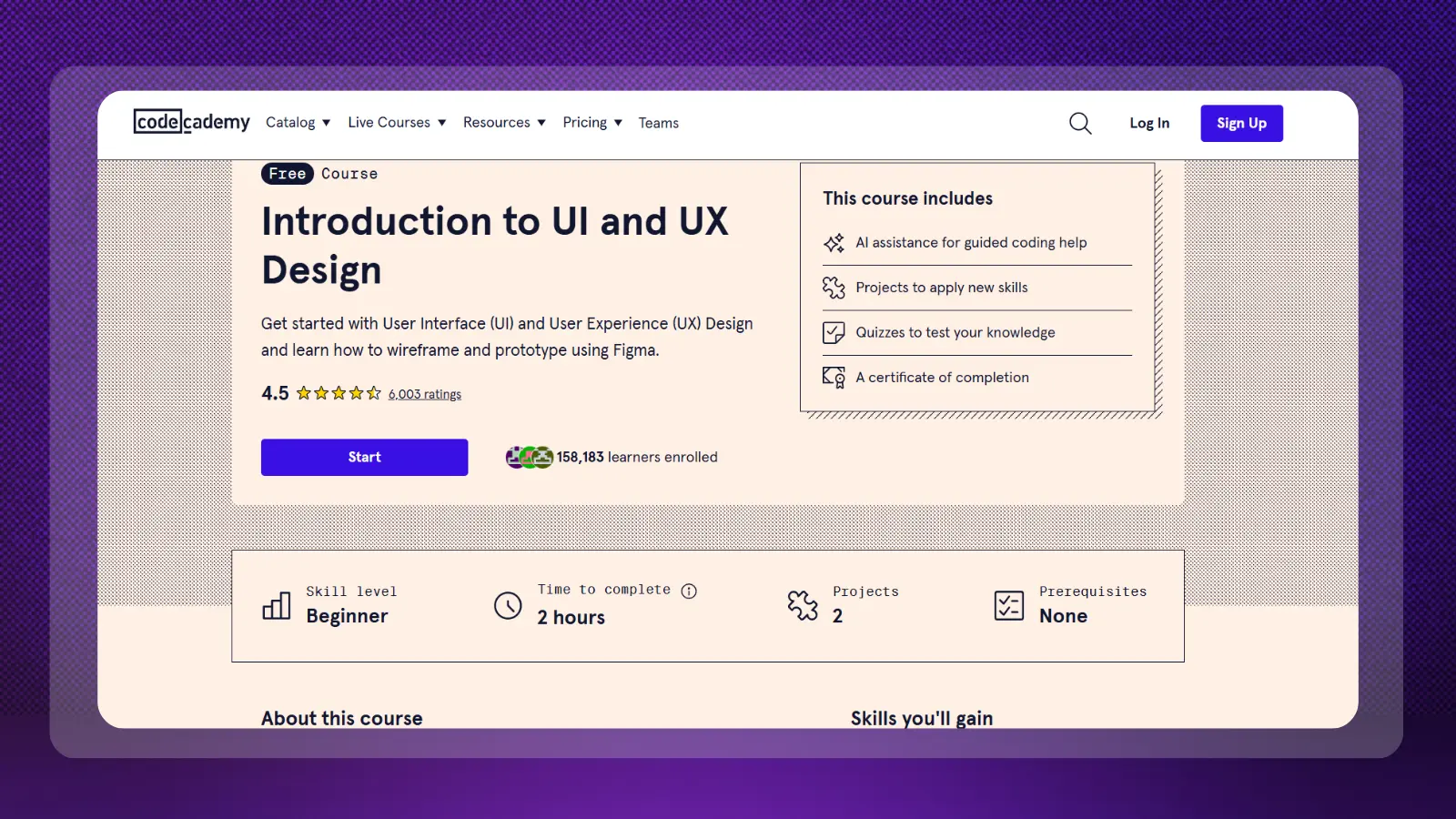
Codecademy‘s Introduction to UI and UX Design web design course introduces interface and experience design, with wireframing and prototyping in Figma.
The best web design courses for this goal should help you explain design decisions. A useful practice task is a game community signup flow. Sketch what information the visitor needs, then consider how to communicate an error or a successful submission.
The web designer vs web developer distinction is clearer in this workflow. You can use a web design course to plan an interaction before implementing it. An online course on website design can therefore be valuable even when code is outside its immediate scope.
The provider’s course-specific details are summarized conservatively below.
| Provider | Codecademy |
| Price | Free |
| Difficulty | Beginner |
| Time | 2 hours |
| Certificate | Yes (on paid plan only) |
| Rating | 4.5 from 6,003 reviews |
The subject focus is the main reason to consider this web design course.
| Pros | Cons |
|---|---|
| ✅ Interface foundations – introduces UI concepts ✅ Experience focus – connects screens to user tasks ✅ Wireframing practice – plan page structure ✅ Prototyping tool – introduces Figma | ❌ Introductory scope – further practice is needed for complex interfaces ❌ Separate coding study – implementation needs another learning path |
Training for web designers should include decisions about content and interaction, even if their eventual role includes development. Pair this subject with web design and development courses when you want to build your own prototypes. That combination creates broader web design education than either topic alone.
8. Best for Quick Projects: Build a Portfolio Website with HTML, CSS, and JavaScript (Coursera)
This guided project suits readers who already recognize basic web code and want a compact build. Its intermediate label makes it a practice option after introductory web design courses.
The project uses HTML, CSS, and JavaScript to assemble a portfolio website. Coursera presents it as a guided web design course project, so the attraction is a defined task with a limited scope. It is useful when an open-ended online course on website design feels too broad for your immediate goal.
Coursera lists intermediate difficulty, less than 2 hours, and a 4.3 rating from 164 reviews. Those web design course details describe the guided activity. Further revision depends on how much you change the example.
Among the best web design courses for focused practice, this pick has a clear use: turn familiar syntax into a page. Web design education becomes more convincing when the finished project contains your own content and decisions.
The available project details appear below.
| Provider | Coursera |
| Price | Not listed by the provider |
| Difficulty | Intermediate |
| Time | Less than 2 hours |
| Certificate | Not listed |
| Rating | 4.3 from 164 reviews |
Treat this web design course project as a focused exercise within a broader learning path.
| Pros | Cons |
|---|---|
| ✅ Clear outcome – a portfolio website ✅ Combined skills – HTML, CSS, and JavaScript ✅ Guided format – a defined activity ✅ Compact scope – a short project commitment | ❌ Intermediate level – beginners may need earlier lessons ❌ Narrow coverage – limited room for broader design theory |
Training for web designers should include an unguided follow-up. Change the navigation, rewrite the content, and explain your layout choices. The web designer vs web developer comparison then becomes practical: you can see which parts of the work engage you most. Broader web design and development courses can address the gaps this project reveals.
9. Best Course Bundle: One Month Web Development Bundle (One Month)
This bundle suits learners who want related subjects packaged together. Consider it when comparing web design courses that extend beyond page styling into broader programming ideas.
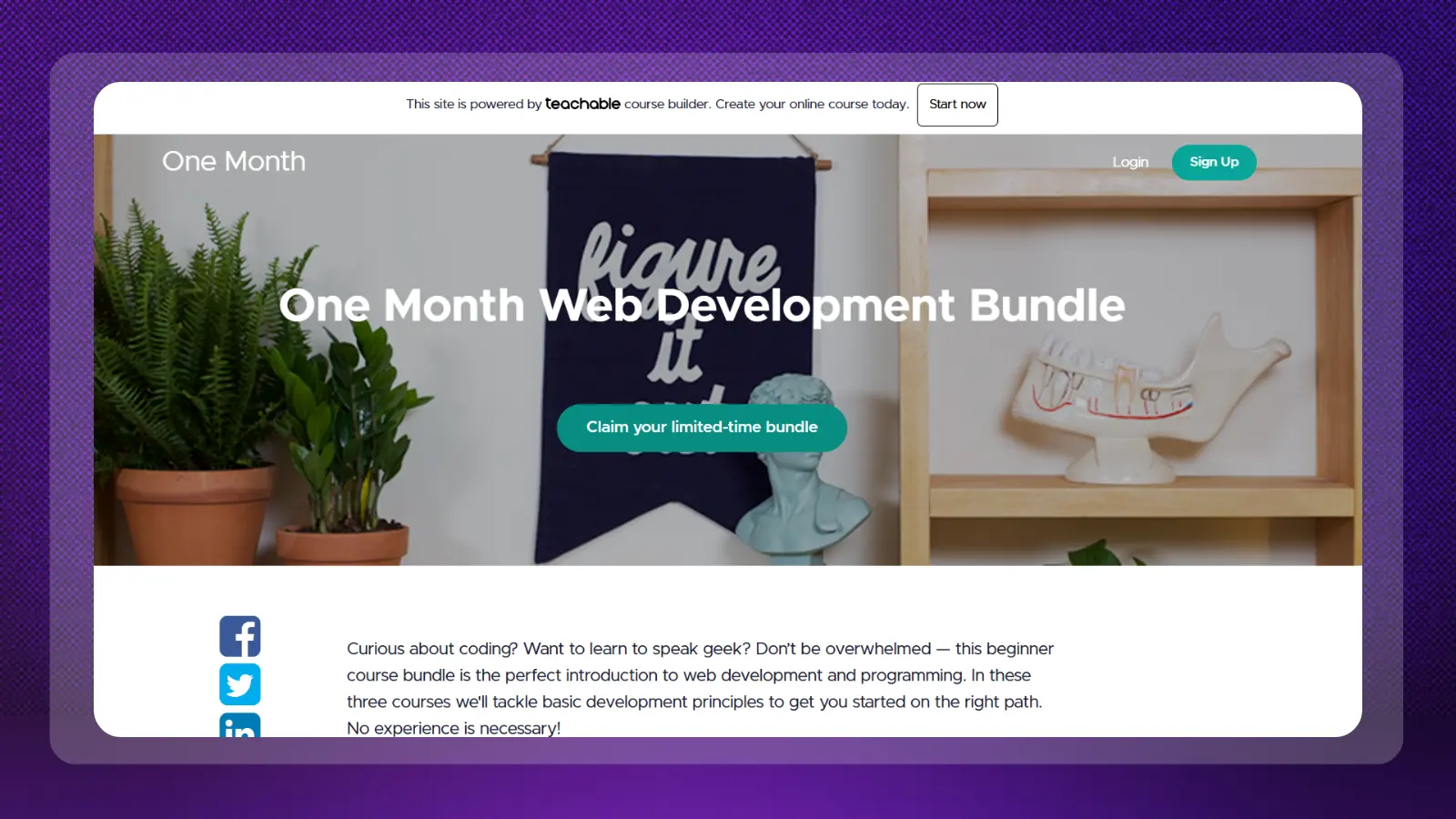
Hosted on Teachable, the One Month bundle includes Programming for Non-Programmers, One Month Rails, and One Month Responsive Design. Ruby on Rails is a framework for building web applications. Including it gives this web design course bundle a broader development focus than a visual-design introduction.
One Month lists a $99 bundle price. The responsive-design description presents a progression toward intermediate skills. Treat the course name as branding and organize study around the work required.
The best web design courses for a focused design goal may be narrower than this bundle. An online course on website design should match the skills you intend to use, so consider how much application development belongs in your plan.
Available information about the web design course bundle appears here.
| Provider | One Month |
| Price | $99 list price |
| Difficulty | Includes progression toward intermediate responsive-design skills |
| Time | No total duration specified for the bundle |
| Certificate | Not listed by the provider |
| Rating | Not listed by the provider |
These bundled web design courses combine useful subjects, with a wider scope to manage.
| Pros | Cons |
|---|---|
| ✅ Combined curriculum – related subjects in a bundle ✅ Programming introduction – includes non-programmer material ✅ Responsive design – layout study alongside coding ✅ Application exposure – includes Ruby on Rails | ❌ Broad focus – application topics may exceed your design goal ❌ Credential detail – no certificate listed by the provider |
The web designer vs web developer distinction is a useful filter here. Choose the bundle if you want to explore both interface work and application building. For more targeted training for web designers, a layout or UX course may use your attention better. Web design and development courses are valuable when their breadth matches your intended work.
10. Best College-Credit Program: Online Certificate Program in Website Design and Development (UMass Lowell)
Choose this route when academic study and college credit are part of your goal. It serves a different purpose from short web design courses built around a single tool or project.
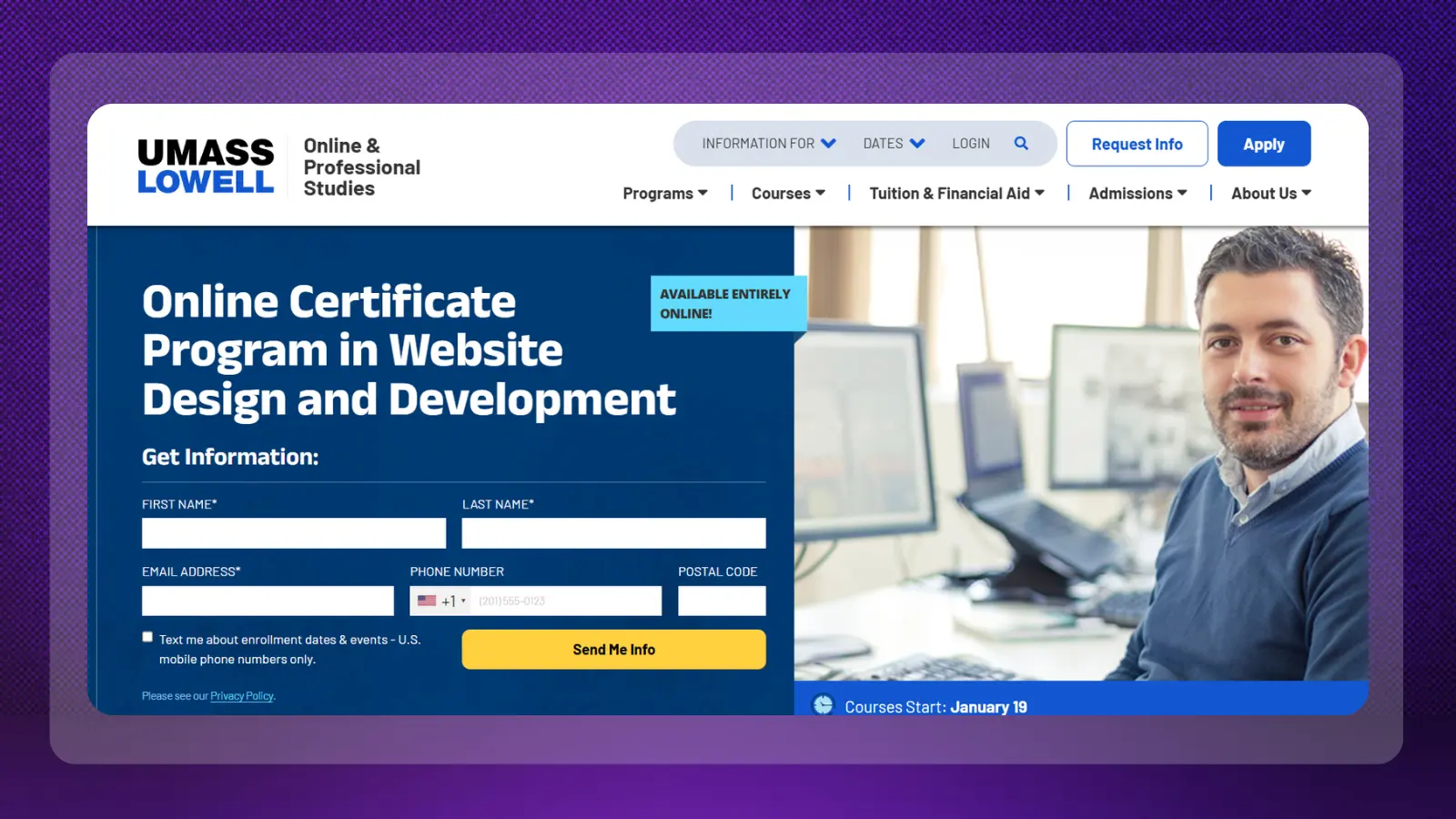
UMass Lowell offers an online certificate with Web Design and Web Development tracks. Its web design courses cover subjects including HTML, multimedia graphics, and website design. This makes it relevant to readers comparing web design and development courses within a university setting.
UMass Lowell lists $385 per credit and a 6–9-month completion period. Per-credit tuition is a different billing basis from a course purchase. Use the program’s required credits and any applicable fees to assess your own total commitment.
The best web design courses for academic goals should fit the credential you actually need. The web designer vs web developer choice is explicit here, so compare the track curricula against the work you want to do.
Main facts about this program’s web design courses are summarized below.
| Provider | UMass Lowell |
| Price | $385 per credit |
| Difficulty | Not listed by the provider |
| Time | 6–9 months |
| Certificate | College certificate |
| Rating | Not listed by the provider |
Academic structure is the reason to consider these web design courses.
| Pros | Cons |
|---|---|
| ✅ College study – an academic certificate pathway ✅ Track choice – design or development emphasis ✅ Online format – study through an online program ✅ Broad subjects – HTML, graphics, and website design | ❌ Longer commitment – broader than a short course ❌ Per-credit billing – the listed rate is not total tuition |
An online course on website design can introduce a skill quickly, while an academic program organizes a longer sequence. Training for web designers through university web design and development courses makes sense when that structure serves a clear educational goal. Compare it with your existing web design education before committing to overlapping subjects.
Free Web Design Courses and Resources
Start with accessible lessons and a small project before making a larger purchase. Free web design education is useful for testing your interest and discovering the topics you need to study next. An online course on website design earns further investment when its teaching style helps you build on your own.
These resources provide practical starting points:
- Visual portfolio lessons: Udemy offers Web Design for Beginners: Using WYSIWYG Web Builder as the free course on this list. Use it to explore page arrangement through a visual workflow.
- Design foundations: Codecademy lists web-design learning options, including interface topics. Select lessons are free, while projects, quizzes, and certificates can require a paid plan.
- Video instruction: Flux Academy provides a beginner web-design video course on YouTube. Pause the web design course to recreate the work instead of watching continuously.
Free web design courses can introduce concepts and workflows. Paid training for web designers can add a more organized sequence, as with The Art of Doing, or live instruction through American Graphics Institute. The best web design courses justify payment through the learning format you need.
How To Choose the Right Web Design Course
Choose according to the work or credential you need next. An online course on website design for a personal portfolio serves a different purpose from academic web design education. The best web design courses make that distinction clear before you pay.
Use these factors to compare web design and development courses:
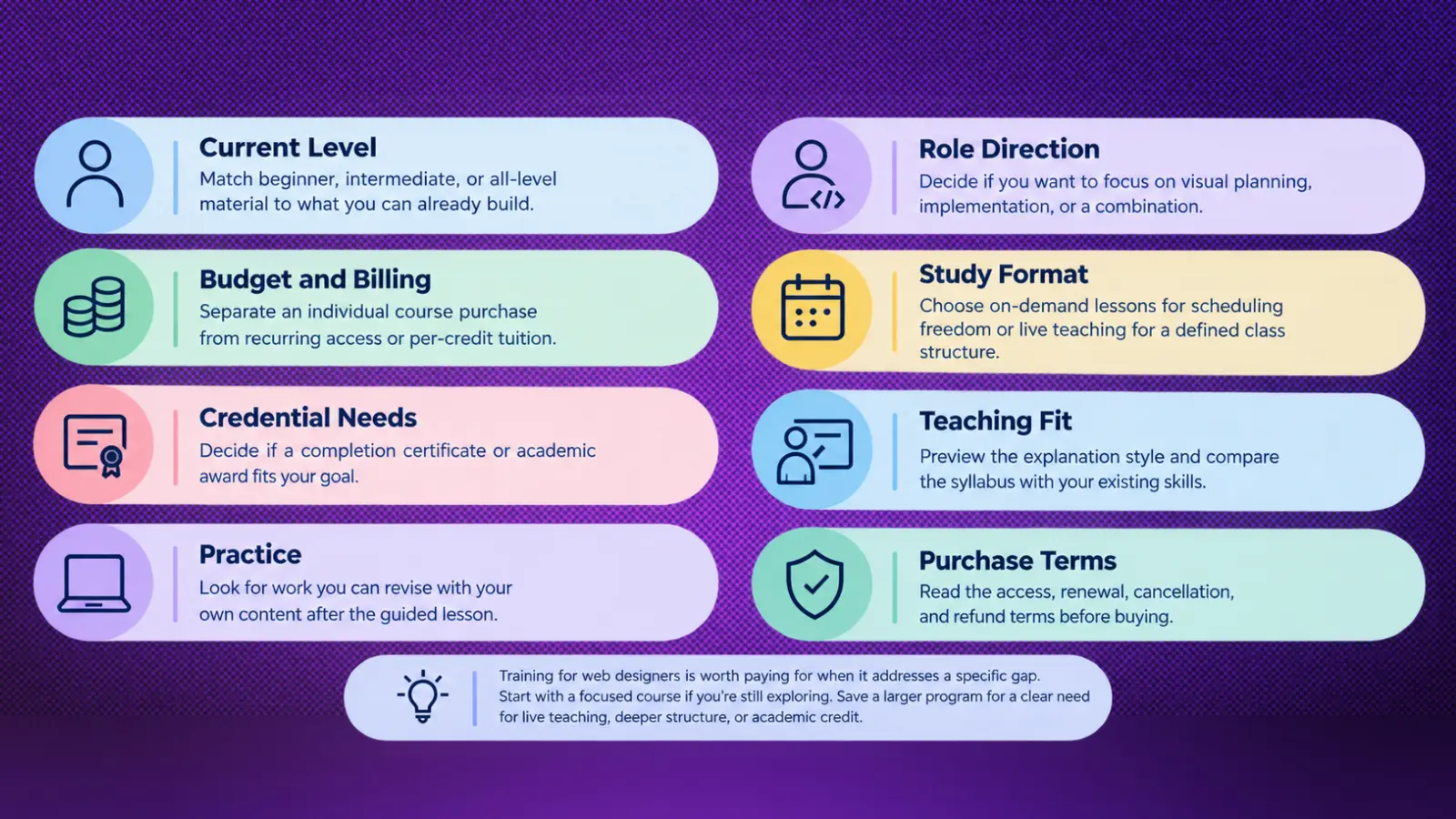
- Current level: Match beginner, intermediate, or all-level web design course material to what you can already build.
- Role direction: Use the web designer vs web developer distinction to choose visual planning, implementation, or a combination.
- Budget and billing: Separate an individual course purchase from recurring access and per-credit tuition.
- Study format: Choose on-demand lessons for scheduling freedom or live teaching for a defined class structure.
- Credential needs: Decide how a completion certificate or academic award relates to your actual goal.
- Practice quality: Look for work you can revise with your own content after the guided lesson.
- Teaching fit: Preview the explanation style and compare the syllabus with your existing skills.
- Purchase terms: Read the access, renewal, cancellation, and refund terms attached to your chosen offer.
Training for web designers is worth paying for when it addresses a specific gap. Start with a focused web design course if you are still exploring. Save a larger program purchase for a clear need for live teaching, deeper structure, or academic credit.
Are Web Design Courses Worth It?
Yes, for most beginners, a suitable course provides useful structure. Web design courses connect related topics and give you a sequence to follow. An online course on website design is most valuable when you complete the exercises and adapt them to your own project.
Training for web designers can also provide feedback or a credential, depending on the program. A web design course alone cannot guarantee employment or client work. Use your web design education to build projects that show your decisions and your ability to revise them.
The web designer vs web developer choice can become clearer through practice. Try visual planning and basic implementation before buying broad web design and development courses. The best web design courses fit a defined goal, while a free starting point lets you explore that goal with less financial commitment.
Final Verdict
HTML, CSS, and Javascript for Web Developers is the best general starting point for coding foundations. Choose The Art of Doing – Web Development for Beginners Specialization if you want a more progressive beginner path. Neither is the strongest fit for someone whose immediate goal is visual prototyping, where interface-design study deserves priority.
Web Design for Beginners: Using WYSIWYG Web Builder is the free visual-building option. The Complete Front-End Web Development Course suits readers ready for a paid web design course focused on coding with an individual purchase option. Consider American Graphics Institute for live instruction or UMass Lowell when academic credit serves a clear goal.
Your web design education should produce work you can explain and improve. Training for web designers becomes useful through that practice. Among the best web design courses, choose the smallest commitment that addresses your current learning gap.
FAQs
The best web design courses include HTML, CSS, and Javascript for Web Developers for coding fundamentals, The Art of Doing for beginners, and Web Design for Beginners: Using WYSIWYG Web Builder as the free pick. American Graphics Institute lists $3,995 tuition and 96 hours of instruction.
Yes, a suitable web design course provides structure and practical exercises. Training for web designers is most useful when you revise projects on your own. Choose a certificate program when its teaching format or academic award serves a specific goal.
Yes, Udemy‘s Web Design for Beginners: Using WYSIWYG Web Builder offers free lessons. Free video resources can also begin your web design education. Build and revise a project alongside the lessons to develop usable skills.
Coursera lists less than 2 hours for its portfolio project, while UMass Lowell lists 6–9 months for its certificate. These are course completion schedules; learning speed also depends on your starting skills and practice.
Yes, some do. The listed Coursera courses and specializations offer shareable certificates, and Udemy‘s The Complete Front-End Web Development Course includes a completion certificate. Credential terms depend on the course and access option.
A designer focuses on layout, visual style, and usability. A developer writes the code behind the site. Web design and development courses can combine these skills. Your preferred mix of visual planning and coding helps you choose the best web design courses.